

The Confusing Truth About Mortgage Rates
If you’ve ever watched mortgage rates and Treasury yields move almost in sync — but not quite — you’ve seen the mystery of the mortgage yield spread in action.
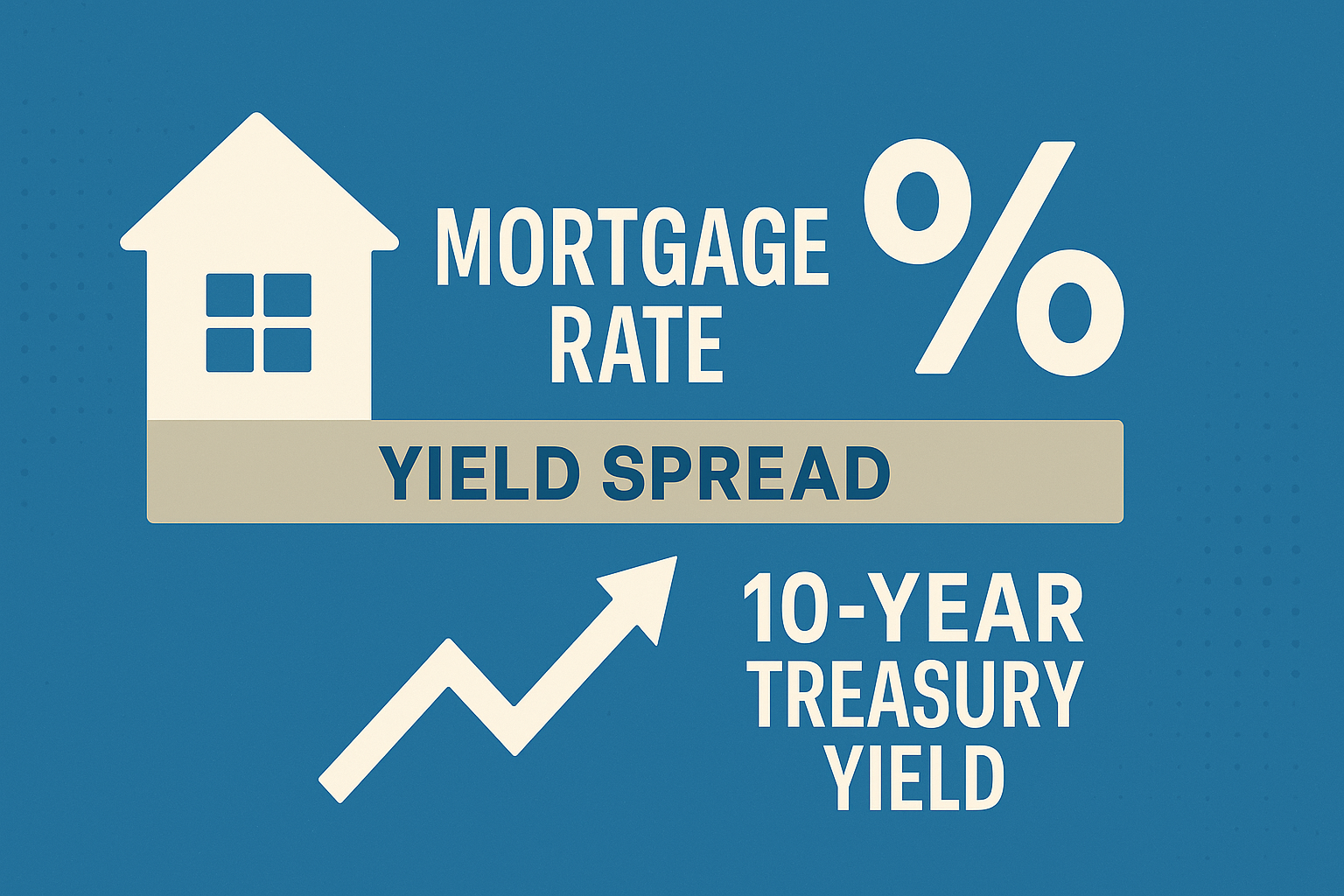
You might expect your mortgage rate to fall the moment the Federal Reserve cuts rates or Treasury yields drop. But it doesn’t always happen that way. That “extra” difference between the 10-year Treasury yield and your 30-year mortgage rate — the yield spread — is one of the most misunderstood pieces of the mortgage puzzle.
What Exactly Is the Yield Spread?
In plain English, the yield spread is the gap between what the U.S. government pays to borrow money for 10 years and what homeowners pay to borrow for 30 years.
Historically, that spread averages about 1.5%–2%. But it’s not fixed — it widens or shrinks depending on how investors feel about risk, inflation, and the economy.
When markets are calm, the spread narrows and rates drop closer to Treasury yields.
When there’s uncertainty — say, inflation fears or global instability — the spread widens. Even if Treasury yields fall, mortgage rates can stay high because investors demand a cushion for the extra risk.
Why the Spread Exists (and Why It’s Not the Lender’s Profit)
Here’s the key point most people miss: the yield spread isn’t just lender markup.
It represents the total cost of turning investor capital into a home loan — covering risks and inefficiencies that don’t exist in the Treasury market.
Here’s what’s inside that spread:
- Credit risk: Home loans carry default risk; Treasuries don’t.
- Prepayment risk: Borrowers refinance or sell early, which hurts investor returns.
- Servicing and funding costs: Lenders must fund, process, and manage loans before selling them.
- Liquidity and capital costs: Mortgages aren’t as liquid or predictable as Treasury bonds.
That’s why the spread moves — it reflects market confidence, not greed.
And that’s also why efficient lenders (those who use automation, modern underwriting, and strong investor relationships) can often pass savings back to borrowers. Lower operational costs mean lower yield spreads and better rates.
What Today’s Spread Tells Us
As of late 2025, the spread sits around 2.1%–2.3% — still higher than normal, but easing from last year’s volatility. That signals a market that’s regaining balance: investors are less fearful, funding costs are stabilizing, and borrowers are starting to see relief in mortgage pricing.
Put simply, the gap between Treasuries and mortgages is narrowing — and that’s good news if you’re planning to buy or refinance.
Why This Matters to You
Every borrower ultimately benefits from a more efficient mortgage ecosystem.
The more streamlined the process — from pricing to underwriting to servicing — the smaller that yield spread can become.
At Doma Loans, we focus on this exact efficiency: using technology to minimize friction, lower costs, and deliver better rates faster. Because when lenders operate smarter, borrowers win.
The Bottom Line
The yield spread is not a hidden markup — it’s the heartbeat of the mortgage market.
It connects Wall Street to Main Street and explains why mortgage rates don’t always move in lockstep with the Fed.
Understanding it means you can read rate movements like a pro — and know when the market is truly working in your favor.
Doma Loans
Toll-Free: 888-658-3662
Leave a Reply